Summarize with AI
IT teams rarely start with bad systems.
They start with what works: spreadsheets.
At small scale, spreadsheets feel fast, flexible, and cheap. You can track laptops, licenses, renewals, and endpoint details in one file, share it with the team, and move on.
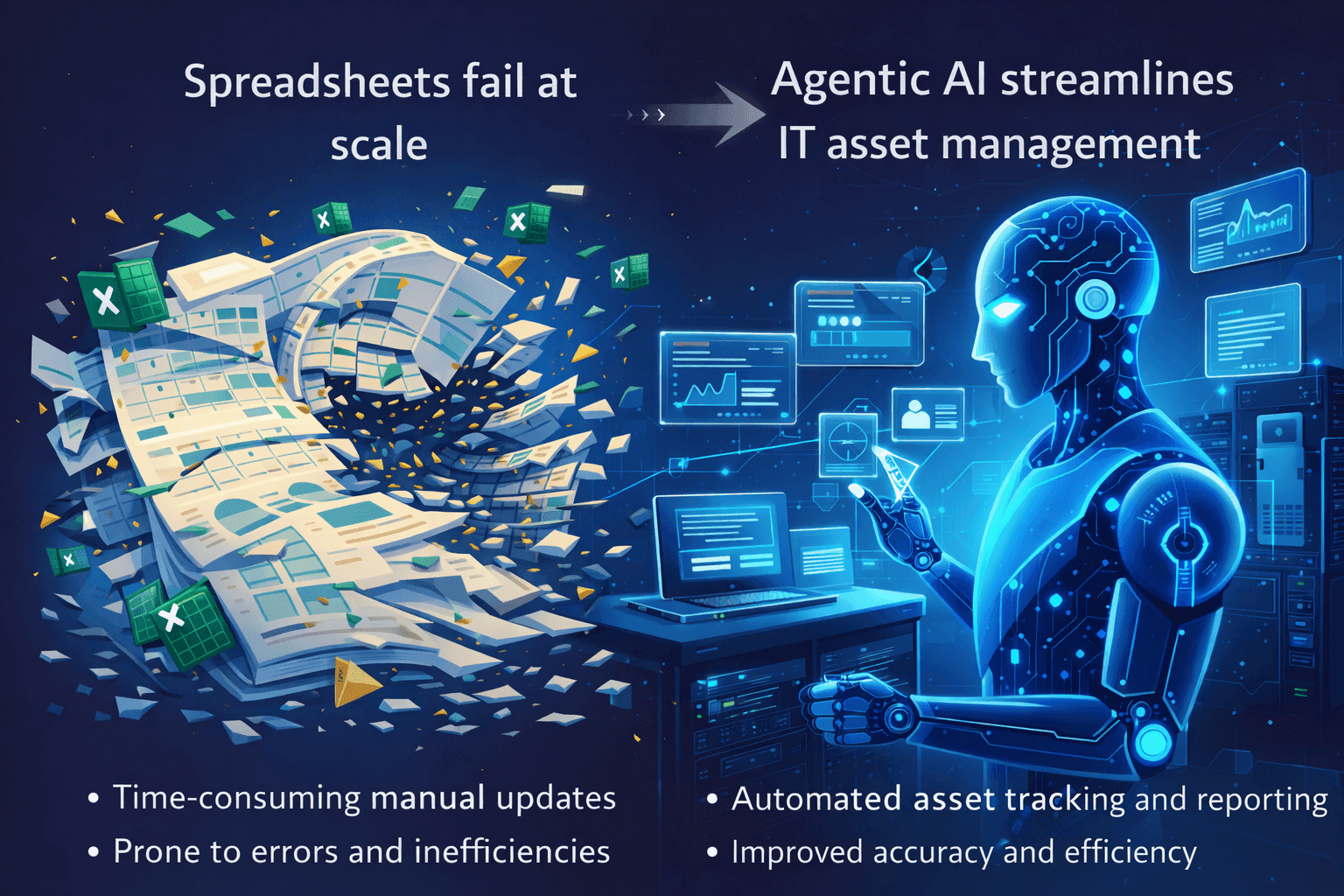
But as organizations grow, spreadsheets stop being a system and start becoming a risk.
When your IT estate expands across locations, cloud environments, hybrid users, and dozens of tools, spreadsheet-based tracking creates blind spots that directly impact cost, compliance, and operational control.
This is where Agentic AI changes the game.
Most IT leaders don’t struggle because they lack data.
They struggle because their data is fragmented, outdated, and disconnected from action.
In spreadsheet-led workflows, common failure points appear fast:
The result: teams spend time collecting data instead of improving decisions.

1) No Real-Time Visibility -Spreadsheets are snapshots. IT operations require live state. By the time a row is updated, the endpoint may have changed owner, software version, or compliance status. This lag creates execution risk across IT operations.
2) License Waste and Budget Leakage- Without continuous usage intelligence, organizations overbuy and underutilize licenses. Duplicate subscriptions, unused software, and delayed deprovisioning quietly drain budgets quarter after quarter.
3) Audit Pressure and Compliance Gaps- Audit readiness cannot depend on manual cleanup. When records are distributed across files and teams, compliance checks become stressful, slow, and error-prone—especially during vendor true-ups and internal audits.
4) Endpoint Drift and Patch Inconsistency -Spreadsheets can list assets, but they cannot enforce endpoint health. Patching, third-party software updates, and policy compliance need continuous monitoring and automated action—not static tracking.
5) No Workflow Orchestration- Spreadsheets don’t trigger workflows. They can’t automatically route exceptions, escalate non-compliance, validate ownership changes, or link ITAM/SAM/ESM events into one execution model.
What looks like a tooling shortcut often becomes a strategic tax:
At Enterprise Scale, this is not an admin issue—it’s a control issue.
Traditional automation follows fixed rules.
Agentic AI goes further: it can observe, reason, and execute across systems.
In IT asset management, that means AI agents can:
Instead of teams chasing data, AI agents maintain operational truth in real time.
To move beyond spreadsheet constraints, teams need a platform that unifies:
ITAM(IT Asset Management): accurate inventory, lifecycle state, ownership, utilization
SAM(Software Asset Management): license intelligence, compliance, rightsizing, renewals
ESM(Endpoint Asset Management): endpoint software deployment, patching, policy adherence
And all three must be connected through one intelligence layer that can act autonomously.
ZioSet is an Agentic AI-native IT Operations platform that turns fragmented IT operations into a unified, intelligent system.
Instead of manual tracking and reactive workflows, autonomous AI agents continuously discover, analyze, and optimize your IT estate in real time.
Core modules (short and clear)
ITAM (IT Asset Management): AI agents auto-discover devices, map ownership, and maintain live asset visibility.
SAM (Software Asset Management): AI-driven license intelligence tracks usage, flags waste, and improves compliance.
ESM (Endpoint Software Management): Autonomous agents orchestrate patching, software deployment, and endpoint policy control.
Why it matters