For years, IT leaders have chased one core goal: asset visibility.
Know what devices exist, where they are, who owns them, and what software is installed. That was the foundation of good IT Asset Management (ITAM), and it still matters.
But in 2026, visibility alone is no longer enough.
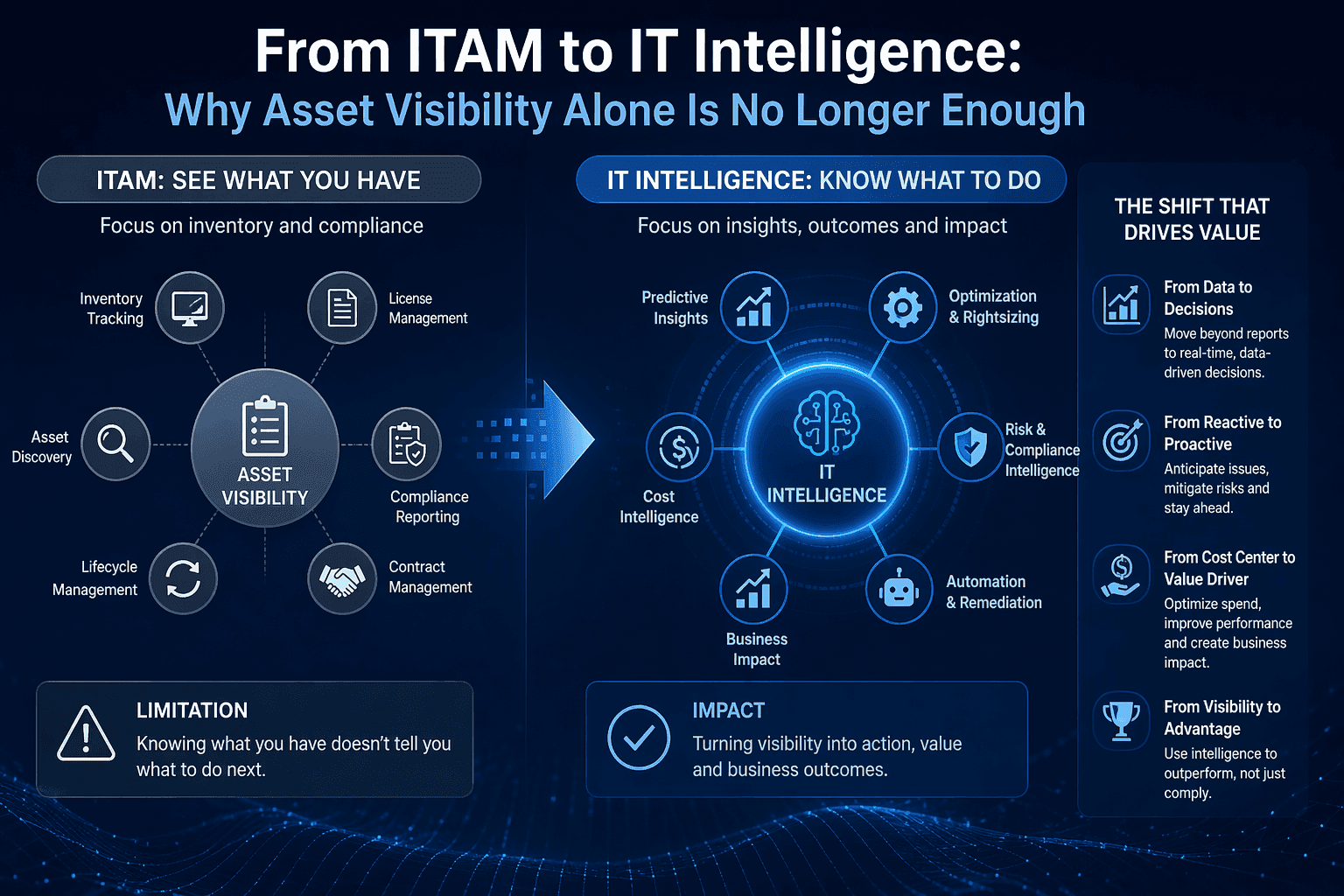
Why? Because enterprises don’t fail today due to missing dashboards. They fail when they can’t turn asset data into timely decisions. They can see what they own, but not what to do next. They know what is installed, but not what is underused, over-licensed, non-compliant, or at risk.
That gap between seeing and acting is exactly where IT Intelligence begins.
Traditional ITAM answers questions like:
Those are necessary questions. But modern enterprises also need answers to harder ones:
In other words, ITAM gives you control of records.
IT Intelligence gives you control of outcomes.
Most enterprises already have tools for inventory, discovery, and reporting. Yet the same issues persist: overspend, audit stress, fragmented ownership, and slow operational response.
Here’s why:
Asset data, software entitlements, endpoint health, and service workflows often live in separate systems. Teams see fragments, not one operational truth.
Quarterly or monthly snapshots can’t keep pace with real-time changes in cloud usage, SaaS subscriptions, and endpoint drift.
Even when insights are accurate, execution still depends on ad-hoc handoffs, spreadsheets, and slow approvals.
Many organizations prepare for compliance only when an audit is approaching, instead of maintaining continuous evidence readiness.
Visibility is the first step.
But without intelligence and orchestration, visibility becomes expensive hindsight.
IT Intelligence is not just “more analytics.” It is the combination of:
A mature IT Intelligence model should continuously answer:
That loop transforms IT from passive reporting to active operational leadership.
To move from ITAM to IT Intelligence, enterprises typically evolve in four stages:
A central inventory with ownership, lifecycle, and status baseline.
Expanded coverage across software, endpoints, and utilization signals.
Correlated insights on cost waste, compliance posture, and risk patterns.
Workflow-driven actions: reclaim, right-size, patch, retire, escalate, and prove compliance.
Most organizations are stuck between Stage 2 and Stage 3.
The real gains happen when they operationalize Stage 4.
The move to IT Intelligence creates value across three executive priorities:
This is why CIOs and CFOs are increasingly aligned:
IT Intelligence improves both governance quality and financial discipline.
Enterprises don’t need AI for headlines. They need AI for execution quality.
Agentic AI contributes when it helps teams:
The goal is not to remove human control.
The goal is to remove manual friction from high-volume, repeatable operational decisions.
If you want to start this transition without disruption, use a phased approach:
Connect ITAM, SAM, ESM, and key business systems into a common operational context.
Choose two high-impact use cases first (e.g., license optimization + compliance readiness).
Convert insights into repeatable workflows with clear ownership and SLAs.
Define policy controls, approval gates, and evidence standards before scaling automation.
Expand to broader lifecycle and optimization programs once the first loops prove value.
This approach minimizes risk while building trust across teams.
Asset visibility remains essential.
But visibility without intelligence is observation, not transformation.
The enterprises that lead in the next decade will be those that evolve from:
“What do we have?”
to
“What should we do next—and how fast can we do it safely?”
That is the shift from ITAM to IT Intelligence.
And that is where modern IT operations become a strategic advantage, not just a support function