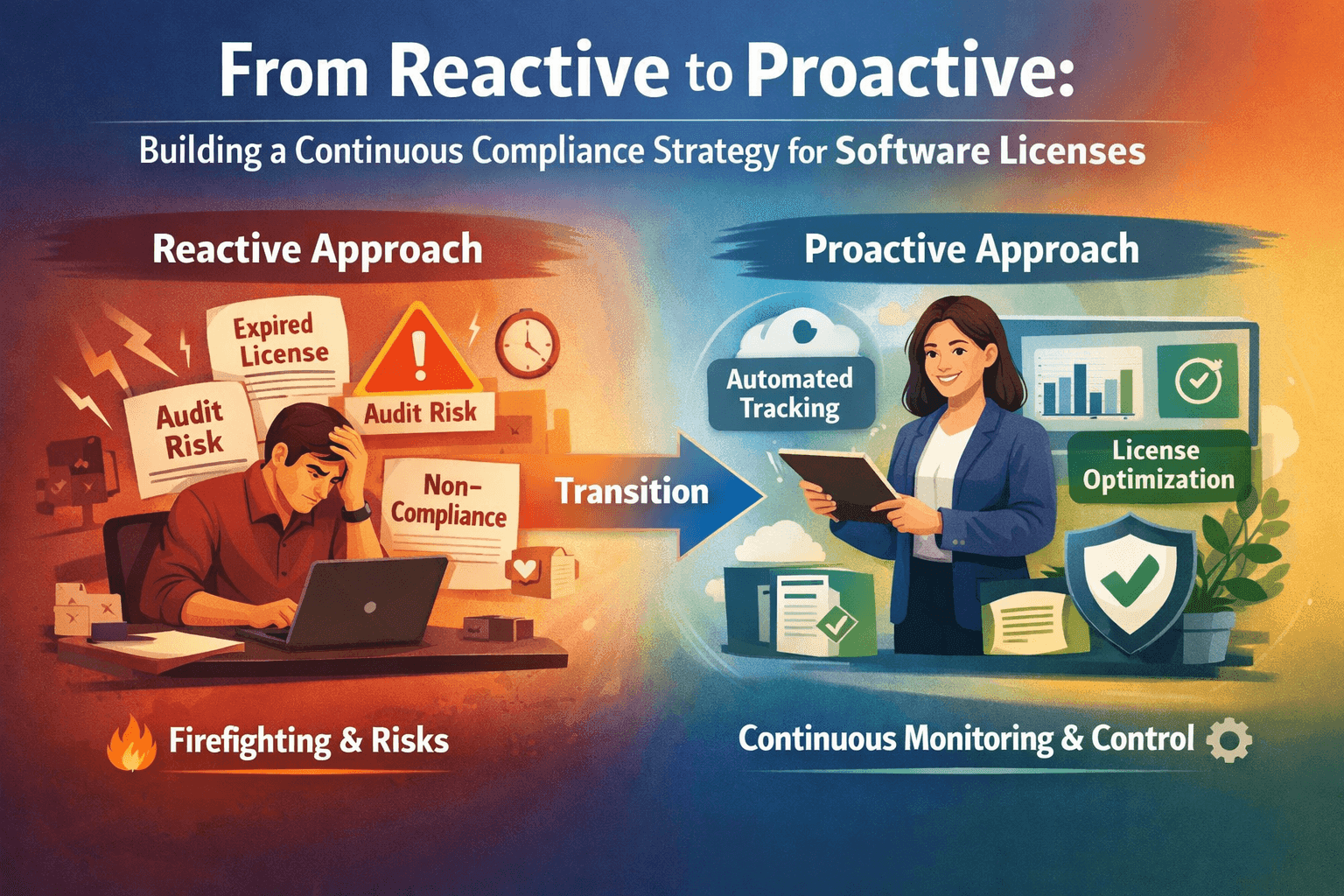
From Reactive to Proactive: Building a Continuous Compliance Strategy for Software Licenses
From Reactive to Proactive: Building a Continuous Compliance Strategy for Software Licenses
For many IT teams, software license compliance follows a familiar pattern: it stays quiet for months, and then an audit notice arrives. People scramble for data, spreadsheets circulate, and decisions are made under pressure.
This is a reactive model, and in 2026, it’s too costly.
A proactive, continuous compliance strategy doesn’t just reduce audit stress. It improves software spending, strengthens security, and gives leadership confidence that the organization is in control—not guessing.
This blog explains how to build that strategy in practical terms.
Why Reactive License Compliance Keeps Failing
Reactive compliance creates a repeating cycle:
- Software gets deployed faster than governance can keep up.
- Entitlements, installations, and usage start to drift apart.
- Visibility gaps widen across teams, regions, and tools.
- Compliance checks happen only before audits or renewals.
The result is predictable: true-up surprises, rushed reconciliations, potential penalties, and lost negotiating power with vendors.
The main issue is not effort; it’s timing.
You cannot perform quarterly compliance checks in an environment where software changes daily.
What “Continuous Compliance” Actually Means
Continuous software license compliance means you’re always monitoring and reconciling:
- What you bought (entitlements/contracts)
- What is deployed (installations/inventory)
- What is used (actual usage patterns)
- What is allowed (policy/compliance rules)
Instead of periodic cleanups, compliance becomes an ongoing operating capability.
In practice, this shifts teams from:
- Audit prep mode- to always being audit-ready
- Manual reconciliation- to automated evidence generation
- Late risk detection to early risk intervention
The 6 Pillars of a Proactive License Compliance Strategy
1) Unified Software Visibility
Start with a single, reliable software view across on-prem, cloud, and SaaS.
Without a unified inventory, every compliance decision is partial. You need consistent software data, ownership mapping, and lifecycle status in one place.
Goal: One source of truth for software assets and licenses.
2) Real-Time Entitlement Reconciliation
Compliance failures often happen because purchased rights and deployed usage are never compared continuously.
Build a reconciliation layer that answers:
- Are we under-licensed anywhere?
- Are we over-licensed and wasting resources?
- Are we using the wrong editions/tier entitlements?
- Are there vendor-specific usage rule violations?
Goal: Detect mismatches continuously, not just at renewal time.
3) Usage-Aware License Governance
Not all non-compliance is intentional; often it’s unmanaged growth.
Add usage analytics to policy decisions:
- Identify inactive and underused licenses
- Detect unauthorized usage patterns
- Track premium-tier usage against actual need
- Trigger right-sizing recommendations
Goal: Combine compliance and cost optimization.
4) Policy-Driven Workflow Automation
A proactive program needs operational workflows, not just dashboards.
Examples:
- Auto-alert when risk thresholds are crossed
- Route exceptions to the right owner
- Trigger approval flows for non-standard software
- Automate reclamation and reassignment paths
Goal: Reduce manual bottlenecks and close compliance loops faster.
5) Audit-Ready Evidence by Default
When an audit request arrives, evidence should already be in place.
Set up continuous evidence capture for:
- License inventory history
- Assignment and reallocation records
- User activity and usage logs
- Approval trails and exception records
Goal: Shift from preparing for audits to already being prepared.
6) Governance Cadence and Accountability
Technology alone won’t make compliance continuous.
Define ownership clearly:
- IT Asset Management/Software Asset Management lead for governance
- Security for policy alignment
- Procurement/finance for renewal strategy
- Business owners for software justification
Run a consistent cadence:
- Monthly optimization review
- Quarterly vendor strategy checkpoints
Goal: Make compliance a regular process, not a panic event.
A Practical 90-Day Rollout Plan
Days 1–30: Baseline and Visibility
- Consolidate software inventory sources.
- Map top vendors and high-risk license models.
- Identify critical compliance gaps.
- Set initial compliance KPIs.
Days 31–60: Reconciliation and Controls
- Implement checks for entitlement vs. usage.
- Define risk thresholds and alerting.
- Set workflow routing for exceptions.
- Build first audit evidence templates.
Days 61–90: Automation and Operating Cadence
- Automate low-risk compliance actions.
- Start license right-sizing workflows.
- Launch recurring compliance governance meetings.
- Prepare an executive dashboard for trends and outcomes.
KPIs That Prove Your Strategy Is Working
Track metrics that reflect both risk and business value:
- Software compliance rate by vendor
- Number of unresolved compliance alerts
- Time-to-resolution for license exceptions
- Reclaimed/reallocated licenses per month
- Audit readiness score (evidence completeness)
- Renewal savings driven by usage intelligence
These KPIs help shift compliance from a cost center to a strategic IT outcome.
Common Mistakes to Avoid
- Treating compliance as a one-time project.
- Running Software Asset Management disconnected from IT Asset Management and endpoint operations.
- Measuring only avoided penalties, not increased operational efficiency.
- Building dashboards without clear workflow ownership.
- Over-relying on manual spreadsheets in fast-changing environments.
Final Thoughts
Reactive software license compliance seems manageable until it isn't.
A proactive, continuous model provides something more valuable than just audit defense: control. You can clearly see your software estate, act on risks early, optimize spending continuously, and make renewal decisions based on data instead of urgency.
In short, continuous compliance is not just an improvement in Software Asset Management. It’s a better operating model for modern IT.