Summarize with AI
IT operations faces pressure to move quickly. Incidents must be resolved in minutes. Changes are made continuously. Ticket queues are endless. Software environments spread across SaaS, endpoints, and hybrid infrastructure. Leadership wants automation, often associating it with “AI” as a quick fix.
However, speed without guidelines creates new problems: privileged actions, unnoticed changes, unapproved data use, and decisions that cannot be explained later when auditors, regulators, or customers ask what happened.
Responsible AI in IT operations doesn't mean slowing teams down. It means legitimizing speed: fast when it should be fast, controlled when risks exist, and observable wherever automation impacts production.
This Blog outlines what responsible AI looks like in IT ops and how to balance autonomy with governance without turning your roadmap into bureaucracy.
IT operations is at the crossroads of three significant risks:
That’s why generic “AI productivity” messages fall flat here. In IT ops, AI doesn’t just answer questions; it increasingly participates in workflows that can lead to irreversible actions like closing tickets, modifying configurations, opening privileged sessions, updating records, or launching deployments.
Responsible AI helps ensure this power aligns with enterprise accountability.
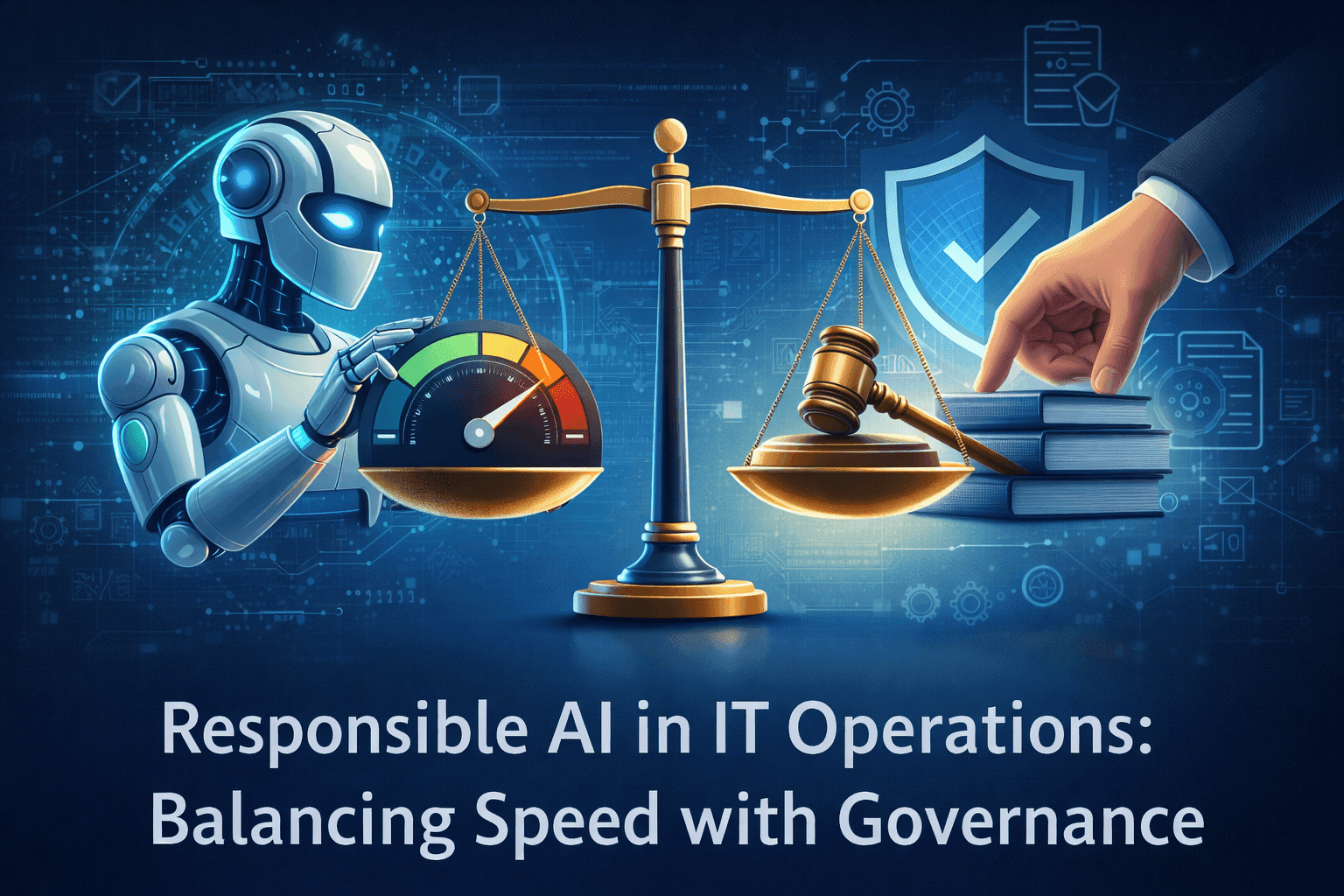
Responsible AI involves a set of design choices, not just a checkbox. In IT operations, it usually includes:
If you can’t explain these six concepts for an AI-assisted workflow, you don’t have responsible deployment; you have experimentation in production.
A common misunderstanding in enterprise IT is that governance requires “manual approval for everything.”
Good governance means tiered autonomy:
This tiered approach helps maintain speed while keeping authority intact.
If governance is disconnected from workflows, teams will find ways around it. Responsible AI programs succeed when governance is integrated into the systems people already use:
Logging and SIEM pipelines capture outcomes, not just model outputs.
This translates into practical terms many teams seek: AI governance in IT operations, human-in-the-loop automation, privileged action controls, audit-ready AI workflows, and enterprise AI safeguards.
If you’re deploying AI agents or copilots that connect to tools (ticketing, ITSM, asset systems, cloud APIs), this serves as a practical baseline:
Specify the tool calls your automation can make, the conditions for those calls, and the limits (rate limits, blast radius, allowed environments).
Use approvals where mistakes are costly, not merely inconvenient. Approvals should be quick templates, not bureaucratic hurdles.
Keep a trace that includes user intent, inputs used, policy version, tool actions, outputs, and timestamps. This ensures responsible AI is compatible with IT audits and operational postmortems.
Track unexpected tool usage, privilege escalations, repeated retries, unusually broad queries, and shifts in outcome distributions (“Why did the bot suddenly close 10x tickets?”).
Version them, test in staging, and roll out with measurable success criteria—use the same discipline as any operational change.
Not “the AI decided.” Someone must own the policy, the model behavior guidelines, and the escalation path.
These patterns often maintain velocity without sacrificing governance:
This approach builds trust: maintaining predictable control in uncertain times.
Many “AI failures” in IT ops stem from data governance failures, not model failures:
If you’re investing in agentic AI—systems that plan multi-step tasks and interact with tools—your initial focus should often be on inventory accuracy, entitlement clarity, and integration discipline. Models amplify whatever structure you provide them.
If executives ask, “Are we doing this responsibly?” you can respond in four stages:
Most enterprises should stay in stages 2 and 3 for a considerable time. Stage 4 is selective, not universal.
The winning teams won’t be those that move fastest with AI. They’ll be the ones that run quickly without surprises: fewer outages, fewer audit findings, fewer security issues, and fewer “we don’t know why the system did that” moments.
Responsible AI in IT operations is how you build that trust—by combining intelligent automation with clear boundaries, evidence, and human accountability.
If you’re evaluating platforms, ask vendors the tough questions: What can it do? What can’t it do? What does it log? Who can stop it? How do you prove its behavior? The answers are more important than any benchmark score.